Changing the modification date is not a content refresh. The article must earn the new date by revalidating the result readers came for.
The implementation boundary
Review search intent and competing internal pages, rerun the demonstration, update screenshots and commands, verify links and metadata, then decide whether the page should remain, merge, or redirect.
For Update Old SEO Articles by Revalidating the Result, the useful boundary is the smallest complete result that the repository can demonstrate. Supporting details stay in this guide when separating them would create a weaker URL, and claims stop where the saved output stops.
Reproducible example
Run the following command from the repository root with the supported Node runtime:
git diff --stat HEAD~1 HEADThe evidence directory for update-old-posts-seo-workflow stores this exact command and its result beside the image. An editor can therefore rerun git after a dependency, route, or hosting change and compare like with like.
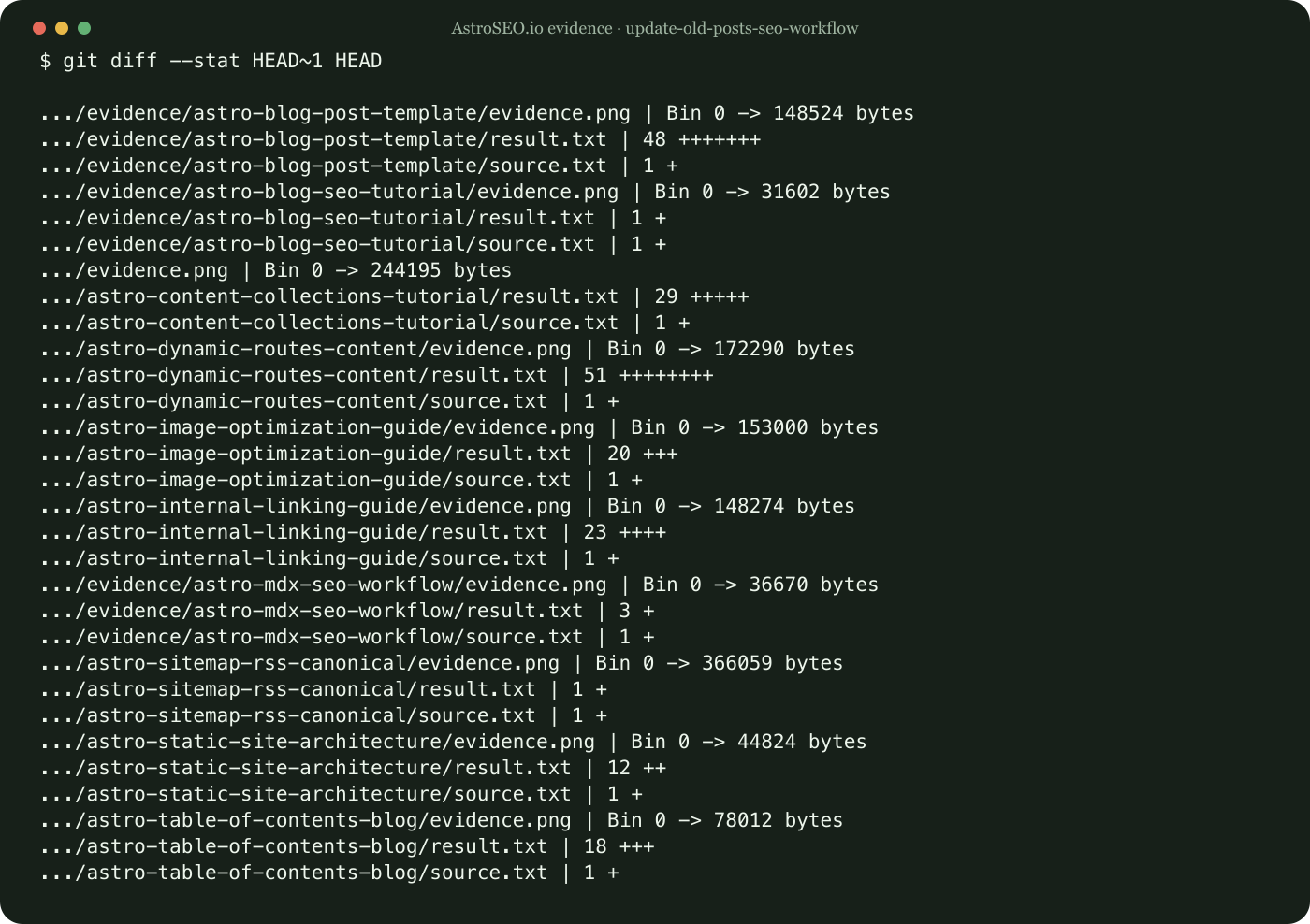
What happened in this site
This rebuild retains stable URLs for strong intents while moving component-level material into pillars. The before-and-after diff therefore represents both rewriting and deliberate deletion.
The update-old-posts-seo-workflow case records what happened in AstroSEO.io rather than presenting one repository as a universal benchmark. Apply this content workflow check to your own URL model and compare the observed output before adopting the recommendation.
A reliable working sequence
- Define what a successful Update Old SEO Articles by Revalidating the Result result should contain.
- Run
git diff --stat HEAD~1 HEADagainst the current production build. - Save only the output relevant to update-old-posts-seo-workflow and redact private account data.
- Compare the observed content workflow artifact with the intended inventory.
- Make one focused correction, rebuild, and repeat this update-old-posts-seo-workflow check.
Using the same update-old-posts-seo-workflow measurement before and after a change separates diagnosis from guesswork and leaves a defensible rollback point.
Verification
Repeat the displayed command for Update Old SEO Articles by Revalidating the Result, confirm its exit status, and compare the current output with the saved result. Open the generated route afterward and inspect its canonical URL, contextual links, evidence image, and narrow-screen layout. For this topic, a green build is not sufficient when the inspected artifact is wrong.
Continue with the next implementation guide and the related verification guide.
Limitations and recommendation
Refresh when the result, interface, policy, or reader decision has materially changed. Avoid calendar-driven edits that add words without improving accuracy.
For update-old-posts-seo-workflow, automate the objective check shown above and keep the final usefulness decision with an editor. Static generation makes this content workflow output inspectable, but it cannot decide whether the explanation is distinct enough to deserve its URL.